Revolutionary communism and underground resistance
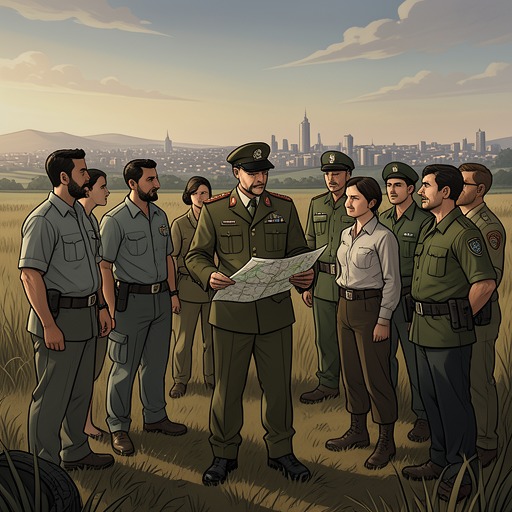
The SympathizerRevolutionary communism and underground resistance are presented as both an ideology and a disciplined clandestine structure. Through Man’s teaching, the unnamed narrator learns that revolutionary commitment depends on secrecy, hierarchy, and patient work across borders. The underground does not end when the South Vietnamese regime collapses: it continues through a covert mission among exiles, a chain of committees whose members remain unknown to one another, and coded letters that turn ordinary correspondence into a channel for intelligence.
A clandestine education
The system begins in the unnamed narrator’s school years, when Man forms a three-person study cell with him and another classmate. While Bon follows a conventional public path, the narrator and Man pursue a concealed one. Man leads the group through revolutionary classics and Party ideology, making political education the first work of resistance. The cell is not an informal circle of friends alone: it is a unit within a larger structure, and its members’ partial knowledge of that structure is deliberate.
Man explains that he belongs to another cell as its junior member, but the identities of his fellow members are withheld from the narrator. Above Man stands another committee for those considered more committed, and above that still more layers of authority. The chain continues toward Uncle Ho, imagined as the most committed revolutionary. Secrecy and hierarchy are not incidental precautions; they are presented as necessary principles of the organization, limiting what any one member knows while connecting local study to a larger movement.
Inherited anticolonial conviction
Man’s account of his revolutionary inheritance gives this organizational discipline a family history. His great-uncle had been compelled by the French to serve in Europe during the First World War as a gravedigger. Burial work exposed him to the bodies of young French soldiers and to the inequality between France’s treatment of its own people and the colonial subjects it governed. The great-uncle came to see the colonial officials sent to Indochina not as demigods but as social outcasts and mediocrities, and this reversal of the colonial image helped form his radical anticolonialism.
His political development also had a personal dimension: he fell in love with a French nurse who was a Trotskyist and persuaded him to join the French communists. They had a daughter, Man’s aunt, who remained in Paris without joining the Communist Party. This history does not make revolutionary belief a simple inheritance, but it shows how political commitments travel through family stories, intimate relationships, and experiences of colonial power. Man recounts the history to the narrator as part of a practical lesson in how the underground survives.
The mission among the exiles
After learning of The General’s evacuation plan, the unnamed narrator tells Man. In the basilica, Man gives him a new assignment from superiors whose identities he does not disclose. The mission continues the same compartmentalized method established in their school cell: the narrator is told what he needs to do, not who ultimately directs him. His task is to keep watch on the exiled soldiers and see that they do not cause too much trouble, rather than to join The General’s fighting plans openly.
Man argues that the narrator can do more good in America than by remaining in Vietnam. He also invokes Bon: Bon will not leave if he believes the others are staying. The appeal makes the mission a test of divided loyalties. The narrator has already imagined refusing Claude’s plane and remaining with The General, but Man challenges him to admit that he wants to go. The assignment therefore serves the underground’s purposes while carrying the narrator into the American exile he both anticipates and resists.
Blood brotherhood and political division
The cell’s political discipline coexists with the childhood oath binding the narrator, Man, and Bon. They cut matching scars into their palms as boys and pledged, “Your blood is mine and mine is yours.” The scar remains visible when they reach for a bottle, cigarette, gun, or woman, turning an adolescent promise into a recurring mark on adult life. Their belief in friendship, country, and independence came before they understood the political paths those convictions might demand.
Those paths diverge sharply. Man and the narrator secretly become revolutionaries, while Bon joins the Phoenix Program to avenge his murdered father, taking aim at people the other two regard as comrades. The narrator’s recollection does not erase that conflict; it distinguishes political allegiance from the original loyalty that made their oath meaningful. In the evacuation’s anxious wait, Bon says that despair is thick but friendship is thicker. The shared scar and their silence afterward briefly hold together men whose political commitments have made them opponents in practice.
A network carried into exile
The underground’s reach becomes visible in the narrator’s later correspondence with Man. Man’s aunt in Paris serves as an intermediary: the narrator sends letters to her, and Man communicates through messages concealed in otherwise ordinary writing. A letter discussing the weather contains invisible ink made from rice starch. The narrator plans to brush the page with iodine in water, revealing purple numbers that refer to page, line, and word in Richard Hedd’s Asian Communism and the Oriental Mode of Destruction.
The coded exchange carries reports that the people’s spirits are high, the country is being rebuilt slowly, and Man’s superiors are satisfied with the narrator’s reporting. Its contrast with the narrator’s account of the exiles is pointed: he believes little is happening among them beyond grief and frustration, while the underground receives a continuing picture of political life at home. A year after Saigon’s fall—or liberation, as the narrator’s divided phrasing allows—the clandestine system remains active across distance. Revolutionary resistance thus persists not only in committees and assignments but in the altered meaning of a family letter, a remembered oath, and the everyday work of reporting.